More Value from Your Site, More Value from Your Energy
Battery storage can turn underused space into a productive energy asset while improving how power is generated, delivered, and used. We develop, finance, build and operate system for both customer facilities and the grid.
01.
Storage creates value at two levels: for facilities and for the grid.
Reduce Energy Costs
Increase Reliability
Store Curtailed Generation
Manage Renewable
Supply
Reduce Peak Demand
Relieve Grid Constraints
02.
We place battery systems at your facility or site in one of two ways. Either way, we build, own, and operate the system.
BEHIND THE METER
The battery sits on your side of the meter, charging when power is cheap and discharging at peak to cut your energy and demand charges.
FRONT OF METER
The battery connects directly to the utility grid and we pay you long-term lease revenue for the use of your site.
03.
The American grid is developing a memory. Battery storage installations shattered records in early 2026, with the first quarter alone outpacing any previous Q1 by more than half. That momentum isn’t slowing. Analysts project the total capacity sitting on U.S. soil will nearly quadruple by 2031, growing from today’s footprint into a 200-gigawatt backbone that lets the grid hold energy made at noon, and spend it at midnight. What was once a niche buffer technology is becoming the connective tissue of a fundamentally redesigned power system.
Source: U.S. Energy Information Administration
04.
Battery storage can work at customer sites, alongside generation, or as a standalone grid asset. The right location depends on where flexibility creates the most value.
Underused or constrained land, including closed industrial sites, former mines, quarries, and similar properties.
Standalone storage located where transmission or distribution access can support grid and market needs.
Storage paired with solar or other generation to increase flexibility and shift energy to when it is most valuable.
Behind-the-meter storage at commercial, industrial, municipal, and other large energy users.
05.
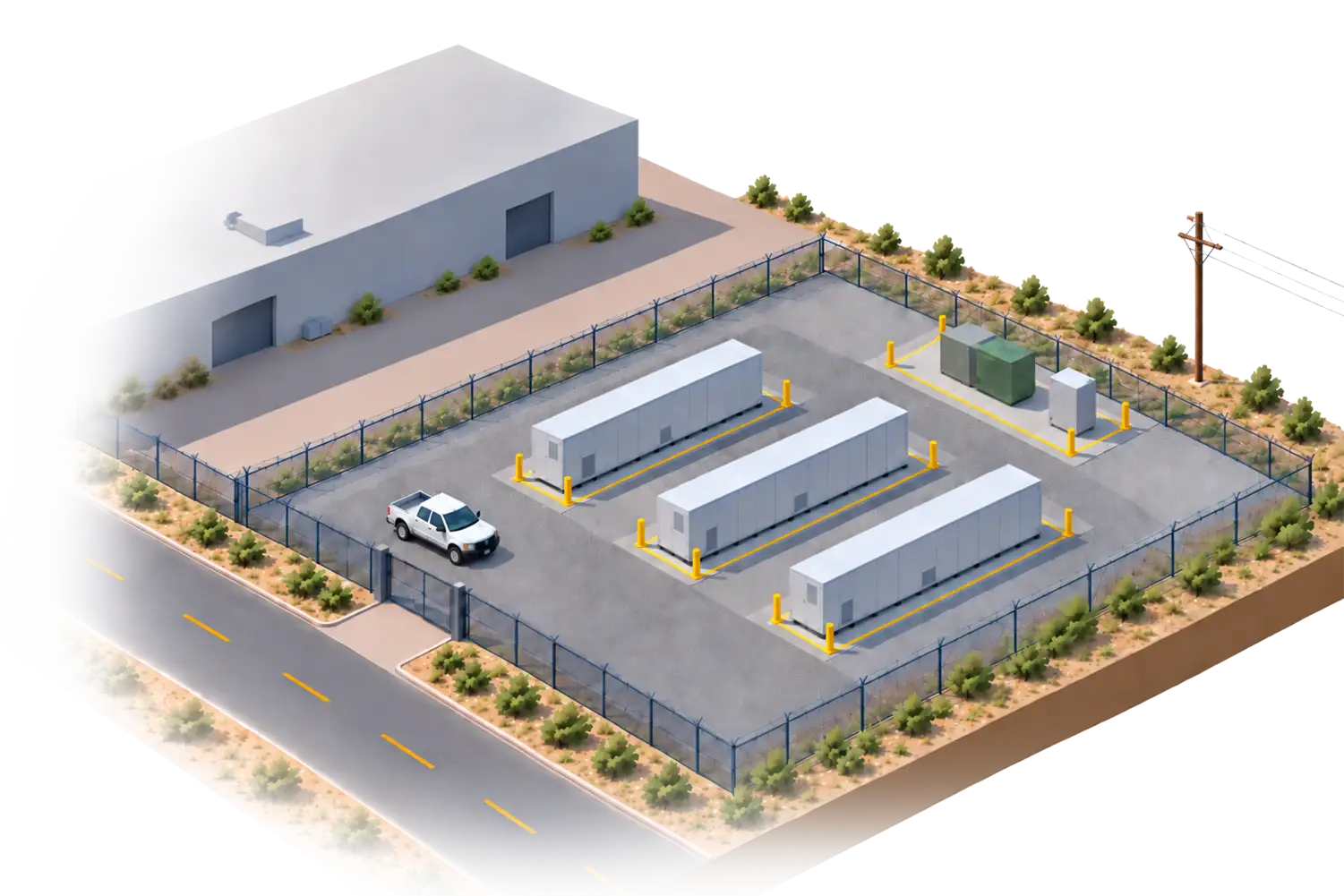
Battery storage requires careful siting, fire protection, access, setbacks, and coordination with local authorities. We design each project around site conditions and applicable zoning, permitting, and fire-code requirements from the start.
Battery Enclosures
Battery enclosures use UL 9540-listed systems with integrated thermal management, monitoring, detection, and fire suppression.
Spacing & Setbacks
Equipment spacing and setbacks are informed by UL 9540A testing, NFPA 855, and applicable local requirements to reduce risk and allow for safe access, ventilation, and fire separation.
Electrical Equipment
Transformers, switchgear, and interconnection equipment step up voltage and connect the system to the grid in accordance with the National Electrical Code (NEC) and utility requirements.
Access & Circulation
Perimeter access and internal circulation are designed for operations, maintenance, and emergency response in coordination with local fire department requirements.
Containment & Drainage
Battery units and associated equipment are installed on engineered pads with containment and drainage designed to meet applicable state and local environmental requirements and site conditions.
Emergency Response Planning
We work with the local fire department to develop a site-specific emergency response plan, including incident procedures, responder access, and air monitoring where appropriate.
Battery Enclosures
Battery enclosures use UL 9540-listed systems with integrated thermal management, monitoring, detection, and fire suppression.
Spacing & Setbacks
Equipment spacing and setbacks are informed by UL 9540A testing, NFPA 855, and applicable local requirements to reduce risk and allow for safe access, ventilation, and fire separation.
Electrical Equipment
Transformers, switchgear, and interconnection equipment step up voltage and connect the system to the grid in accordance with the National Electrical Code (NEC) and utility requirements.
Access & Circulation
Perimeter access and internal circulation are designed for operations, maintenance, and emergency response in coordination with local fire department requirements.
Containment & Drainage
Battery units and associated equipment are installed on engineered pads with containment and drainage designed to meet applicable state and local environmental requirements and site conditions.
Emergency Response Planning
We work with the local fire department to develop a site-specific emergency response plan, including incident procedures, responder access, and air monitoring where appropriate.
The Third Pillar Lifecycle
We take a full-lifecycle approach — developing, owning, operating, and maintaining our projects for the long term, then responsibly decommissioning them and restoring the site at the end of their useful life.
The Third Pillar Ecosystem
The right solution depends on the site, the grid, and the objective. We evaluate the opportunity, then develop, finance, build, and operate the project including solar, storage and infrastructure as stand-alone or integrated solutions.
Solar→
Battery Storage
Infrastructure→