
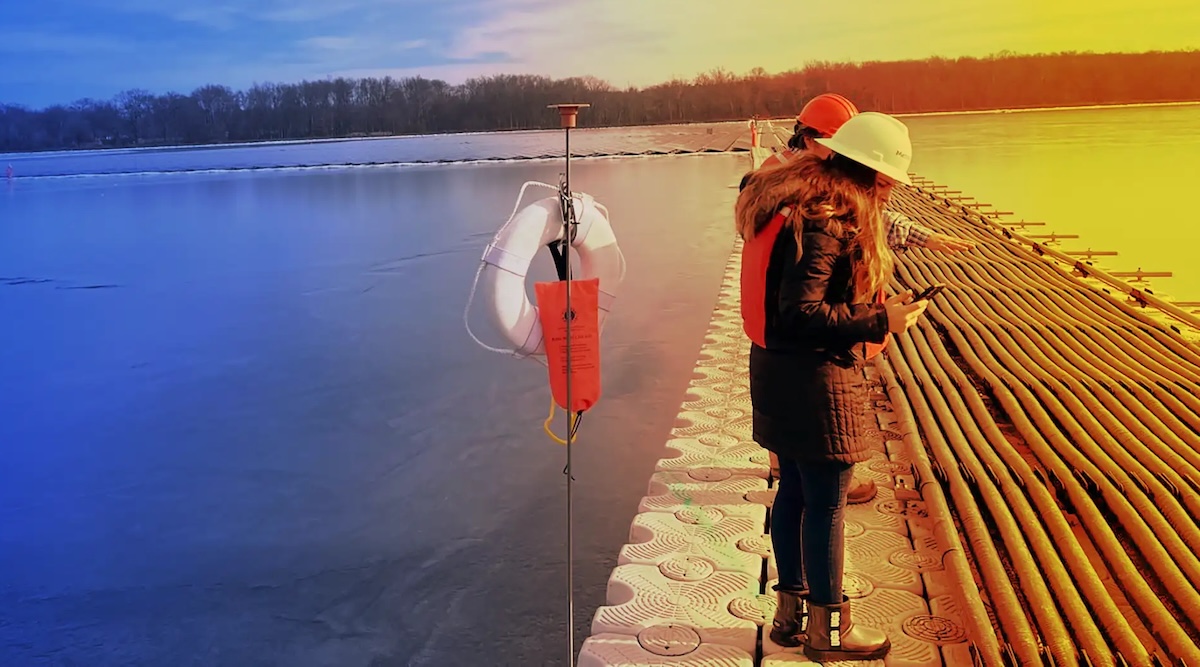
Back in 2018 the US Department of Energy (such as it was back then) assessed the potential floating solar capacity of the US on reservoirs and other human-made bodies of water. After eliminating thousands of unsuitable locations, they still identified over 24,000 potential sites with the combined potential to provide for about 10% of annual US electricity generation at the time.
The appeal of floating solar lies partly in its ability to make space for renewable energy in land-constrained areas. Whether located on reservoirs and other built infrastructure, or on open water, floating PV arrays can also be moored in place with a minimum of site preparation, avoiding considerable expense for developers.
Scaleup is already in evidence in some parts of the world, with the Asian Pacific Region (APAC) being a particular focus of attention. Last year the firm Wood Mackenzie surmised that APAC will account for the fast majority — 57 gigawatts — of an anticipated 77 gigawatts in global solar capacity by 2033.
A study published in the journal Energy & Environmental Science this year affirms the focus on APAC. “Offshore floating photovoltaic (OFPV) systems present a promising opportunity to expand global solar energy capacity, particularly for countries with limited land resources but extensive maritime zones,” the authors note.
The researchers modeled offshore floating solar potential based on economic datasets as well as geographic and climatic data. “The analysis reveals that up to 95% of analyzed offshore regions fall within conditions suitable for current FPV technologies, with Southeast Asia—particularly Indonesia and Malaysia—emerging as optimal early deployment zones due to favorable irradiance, bathymetry, and competitive LCOE,” they concluded, referring to Levelized Cost of Energy, a standard of comparison among different forms of power generation.
More generally, the new study found that in 84% of regions around the world, less than 2% of offshore water surface would be needed to meet current electricity demands.

